What is letter recognition?
Letter recognition is the ability to identify a letter that is being shown or to pick out a specific letter from among a group of other letters. Often, parents begin by teaching children to identify uppercase letters. Letter blocks are typically printed this way, as are magnetic letter tiles, and capital letters have more straight lines, which makes them easier for little hands to form. The problem is, most writing appears in lowercase letters, and only a handful of letters appear the same as both capital and lowercase letters. Take a look at the image below. As you can see, most letters vary significantly between uppercase letters and lowercase letters.
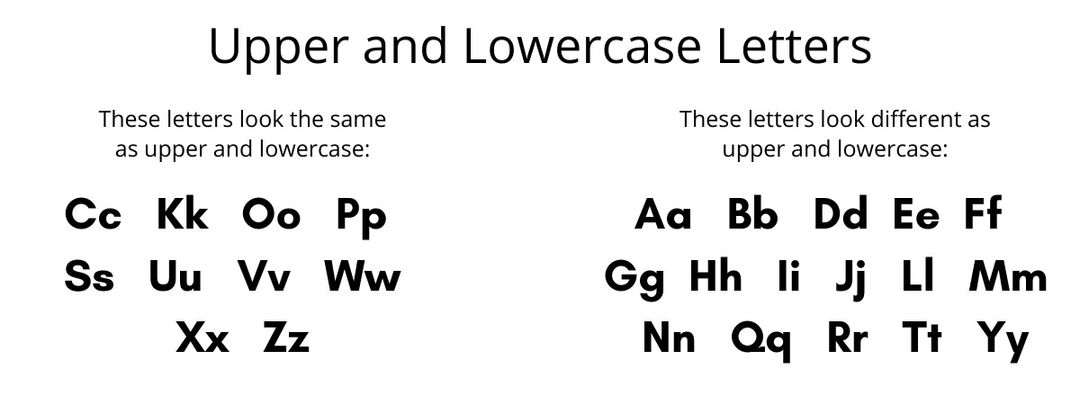
To teach only capital letters would be to do a child a disservice. In order to truly be fluent in letter recognition, it is essential for a child to be able to identify both variations on a letter.
Why is letter recognition important?
One of the first steps to reading is understanding letter sounds. This is called phonemic awareness, and it is something that can be practiced without the aid of written letters. But reading cannot. As children transition to early reading, they must be able to draw a correlation between the letter sound and the physical representation of the letter. Decoding text requires breaking a word apart into its individual phonemes and recognizing the sounds associated with each phoneme. Children who cannot identify the visual representation of a letter, even if they know orally what sound a letter makes, can struggle to recognize words and to read.
What should a child know before learning letters?
While letter recognition is important, it isn’t automatic. Before teaching a child letters, first make sure they understand the different shapes that form letters. Children should be able to discriminate between straight lines and curved lines. They should be able to recognize tall letters and short letters. And they should be able to recognize the difference between letters, numbers, and other symbols—even if they can’t identify the actual symbol.
Encourage your child to sort letter by tall and short, or by straight or curved, or to sort images into letters, shapes, and symbols.
Letter recognition and the ABCs
Many parents begin teaching letters by singing the ABCs. And while this is a great tool for learning the order letters come in, it is not as useful for letter recognition. Looking at letters in order allows children to properly guess at the next letter, even if they can’t truly recognize it. Looking at letters out of order, on the other hand, encourages actual recognition of letter shapes.
What order should letters be taught in?
Because the ultimate goal of letter recognition is learning to read, the best way to start teaching letters is with those that appear most often in combinations of simple words, and which can be combined to form the greatest number of words. These letters are:
Mastering just these six letters enables children to form several simple words: such as sat, sap, nap, sis, pin, pit, and pat. Moreover these letters form what is known as a word’s rime: the combination of letters following the first phoneme in a word (known as the word’s onset) Rime consists of a vowel and final consonant. In the case of these letters, the following word families are formed: -an, -ap, -at, -in, -ip, and -it. Learning to form and recognize these rimes will ready kids for further word formation.
As these letters are mastered, children can move on to more challenging letters.
Be careful not to teach too many letters at once, as this can quickly become confusing. Instead, focus on small groups of letters. The following breakdown represents the generally accepted sequence for teaching letter recognition:
- s, a, t, i, p, n
- c, k, e, h, r
- m, d, g, o
- l, f, b, q, u
- j, z, w
- v, y, x
Pro tip: Some letters look very similar, such as c and o. If your child is getting two letters mixed up, take a step back and separate teaching the two.
How to encourage letter recognition
Teach your child the letters of their name
Names are special, and children take great pride in spelling their own names. Encourage them to learn the letters that form their own names (and if they are ready, work with them on writing the letters. Just remember: names begin with a capital letter, but the rest of the name should be written in lowercase letters.)
Word labels
Label the items around your house. Not only will this encourage children to recognize the letters that go into forming the words, it will help them to realize that the name for an item they frequently use is made up of a string of letters. This early recognition of what words are can go a long way in ultimately recognizing words for reading.
Letter sorting
Encourage your child to sort letters into groups. They may sort by letter, grouping all As together, or by case, grouping all capital letters or lowercase letters together. The more they engage with letters, the more they will remember what they are.
If your child has a strong enough pencil grasp, work with them on letter formation. As they form letters, help them to talk about what the letter is and what sound it makes.


